

Rooted in Curiosity
Some businesses begin with a business plan..png)
Others begin with curiosity.
For Masagana Flower Farm, it started with flowers, food, creativity, and a growing desire to slow down and reconnect with where things truly come from.
Just outside Winnipeg, surrounded by prairie skies, gardens, and the soft glow of sunset workshops, Masagana Flower Farm has become something far beyond a flower farm. It’s a space where art, nature, science, heritage, and sustainability all intertwine.
And at the centre of it all is founder Lourdes — an artist, grower, natural dyer, and educator helping people experience color in a completely different way.
“Growing up, I didn’t really think colours came from plants,” she laughed during our visit. “You just think they come from a box of crayons.”
But now, colour is everywhere around her.
Not manufactured.
Not synthetic.
Grown.
From Cakes to Flowers
Lourdes’ entrepreneurial journey actually began years earlier with a cake business she ran alongside her mother in the Philippines. After moving to Canada, she continued creating custom cakes while exploring business planning workshops through WeMB.
But flowers slowly pulled her in another direction.
Working as a flower buyer introduced her to the global floral industry. Flowers shipped from around the world, especially during Manitoba winters. At the same time, she was becoming deeply inspired by the “slow food movement” and local farmers’ markets.
That sparked a question:
If there’s a slow food movement…could there also be a slow flower movement?
The answer was yes.
And that realization changed everything.
Turning Flowers into Colour
.png) What began as growing flowers soon evolved into natural dyeing. Using plants, petals, leaves, onion skins, cosmos, marigolds, indigo, and countless other botanicals to create rich organic colours and patterns on silk and textiles.
What began as growing flowers soon evolved into natural dyeing. Using plants, petals, leaves, onion skins, cosmos, marigolds, indigo, and countless other botanicals to create rich organic colours and patterns on silk and textiles.
Inside her studio, scarves hang like pieces of prairie sunsets. Some fabrics are steamed with flowers rolled tightly into silk bundles. Others are hand-dyed in indigo vats through a process Lourdes describes as both artistic and scientific.
“It involves a lot of science…like organic chemistry,” she explained. “But fascinating chemistry.”
Her workshops invite people to explore that process for themselves—picking flowers directly from the garden before transforming them into wearable art.
The experience is tactile, immersive, and deeply grounding. You can feel it the moment you step onto the property.
The Science Behind the Magic
For Lourdes, the science behind natural dyeing is part of what makes it so captivating. During her Tinta Experience workshops, guests explore two completely different natural dyeing methods0—floral dyeing and indigo dyeing—each revealing colour in its own way. Her hope, she says, is that people leave not just with something beautiful they created, but with a new sense of wonder.
“My hope is that it opens their minds into curiosity,” she shared. .png)
As she explained the indigo process, her excitement became impossible not to catch. Boiling water. Indigo vats. Carefully adjusting pH levels. Reduction and oxidation reactions. Watching fabric transform from yellow to green tones into deep rich blues as it reacts with oxygen in the air. “It’s fascinating,” she laughed. “I always joke that if my university organic chemistry class had examples like this, maybe I wouldn’t have struggled so much with it.”
For Lourdes, natural dyeing engages every sense.
You observe the colour changing.
You feel the texture of the fabric.
You smell the botanicals and earthiness of the dye vats.
You watch chemistry happen in real time.
And somehow, in Lourdes’ hands, science becomes approachable, tactile, and deeply human.
Choosing a Favourite Flower
One of the most memorable moments during our conversation came when I asked Lourdes a seemingly simple question:
“What’s your favourite flower?” She laughed instantly. And then completely struggled to choose just one.
First, it was coreopsis, because nearly every part of the flower can be used in dyeing, creating rich burgundy and brick tones across fabric. Then marigolds came up because they’re dependable, vibrant, and one of the first flowers that truly drew her into natural dyeing. But then she stopped herself. “Oh my goodness…I forgot cosmos.”
Suddenly she was pulling apart petals and pointing excitedly to different textiles around the studio, showing how each variety creates entirely different colours and effects. Peach cosmos. White cosmos. Deep red cosmos that oxidize beautifully onto fabric. Scabiosa petals creating soft blue circular and heart-shaped prints. .png)
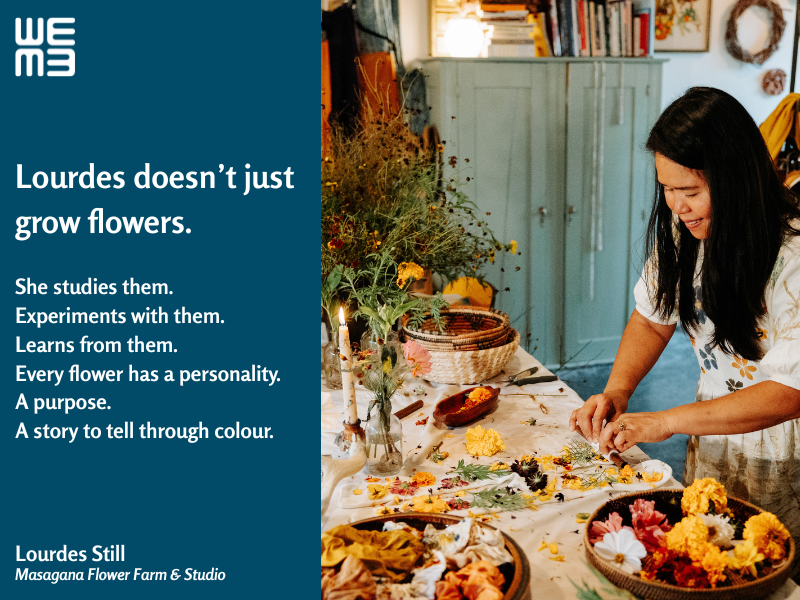
What became so clear in that moment is that Lourdes doesn’t just grow flowers.
She studies them.
Experiments with them.
Learns from them.
Every flower has a personality.
A purpose.
A story to tell through colour.
And listening to her speak about them felt less like talking to a business owner and more like listening to an artist completely in love with her craft.
A Name Rooted in Abundance
.png) The name Masagana itself means “abundant,” “prosperous,” and “bountiful” in Tagalog. For Lourdes, choosing the name was about honouring both her Filipino heritage and the abundance she was discovering around her, not through more consumption, but through deeper connection to the land, creativity, and community.
The name Masagana itself means “abundant,” “prosperous,” and “bountiful” in Tagalog. For Lourdes, choosing the name was about honouring both her Filipino heritage and the abundance she was discovering around her, not through more consumption, but through deeper connection to the land, creativity, and community.
“There is abundance around me just waiting for me to discover it,” she shared. That philosophy can be felt throughout the farm.
Native plants are being restored across the property. Workshops are intentionally timed to end near sunset. Flowers are grown not just for beauty, but for what they can create, teach, and transform.
Even the way Lourdes speaks about soil health, prairie restoration, and sustainability feels less like business strategy and more like stewardship.
More Than a Flower Farm .png)
And maybe that’s what makes Masagana so memorable.
It isn’t simply about flowers.
It’s about slowing down long enough to notice where beauty comes from.
It’s about curiosity.
About heritage.
About creating with your hands.
About building a business that feels aligned with your values.
And perhaps most importantly, it’s about helping others experience colour, creativity, and connection in an entirely new way.
A Thoughtful Ending
Before I began my journey back into the city, Lourdes shared one final gesture that perfectly reflected the heart behind Masagana Flower Farm. She gifted WeMB a copy of The Flower Farmers—a beautiful publication where she was featured as one of only two Canadian flower farmers included in the book. Inside the cover, she had written a handwritten note to the WeMB team: .png)
“To the WeMB Family,
Thank you for all your support. Please keep doing the great work you are all doing.
I/We need you.”
It was simple, heartfelt, and deeply genuine, much like Lourdes herself.
And somehow, it felt like the perfect ending to a day spent learning that flowers can do so much more than simply bloom.
They can connect people.
Tell stories.
Create curiosity.
And remind us that beauty often grows quietly, patiently, and abundantly—when we take the time to notice it.
Visit Masagana Flower Farm
From natural dye workshops to handcrafted botanical textiles, Masagana Flower Farm offers Manitobans a chance to reconnect with creativity through nature. Learn more about workshops at: Masagana Flower Farm & Studio